
For a business, the real difference between a static and a dynamic website is simple: who can change it. On a static website, content sits inside the code, so most edits need a developer. On a dynamic website, content is managed in an admin panel, so your team can update text, images and products whenever they need to.
If your business changes prices, offers, staff, products or photos more than a few times a year, you almost certainly need a dynamic website. If you need one simple page that rarely changes, static can be perfectly fine. The rest of this guide helps you decide, and shows what to ask a developer before you pay.
What the words actually mean
Developers and business owners often mean different things by these words, which causes expensive misunderstandings.
Static website. Each page is a fixed file. To change a heading or a photo, someone edits the code and uploads it again.
Dynamic website. The words, images and products are stored separately from the design. The site reads that content and shows it in the right place. A staff member can change it through a simple form.
Admin panel. The private screen where your team makes those changes. It may also be called a CMS, or content management system. Sanity and WordPress are two well-known examples.
There is one technical point worth knowing. A modern dynamic website can still deliver very fast, pre-built pages to visitors, while the content stays editable behind the scenes. So you do not have to pick between being able to edit your site and having a fast one. This is how we approach most builds.
The real cost of a static website
A static site can look cheaper on the invoice. The cost usually appears later, in small ways.
- You wait for small changes. A new phone number or a summer offer goes into a developer's queue.
- You pay repeatedly. Each small edit can become another small bill.
- Your site slowly goes out of date. When updates are a hassle, people stop making them. An old offer or a closed branch on your website quietly reduces trust.
- You depend on one person. If that developer becomes unavailable, even simple edits become a problem.
When a static website is fine
A dynamic site is not always the right answer, and anyone who says otherwise is selling something.
A static site can be a sensible choice when:
- You need a single landing page for one short campaign
- The content will rarely or never change
- Nobody on your team will ever want to edit it
- The budget is very limited, and you accept paying for changes later
When you need a dynamic website
Choose dynamic if any of these sound like your business:
- You update offers, prices, events or photos regularly
- You sell products online, even a small range
- You publish news, a blog or job openings
- You need more than one language, and each must stay up to date
- Several people should be able to update different sections
- You plan to invest in SEO, because SEO depends on adding and improving pages over time
Three examples from our own work
A venue. Rozia Convention Center has halls, galleries and separate journeys for weddings and business events. A venue's photos and event information need to stay fresh to keep selling the space.
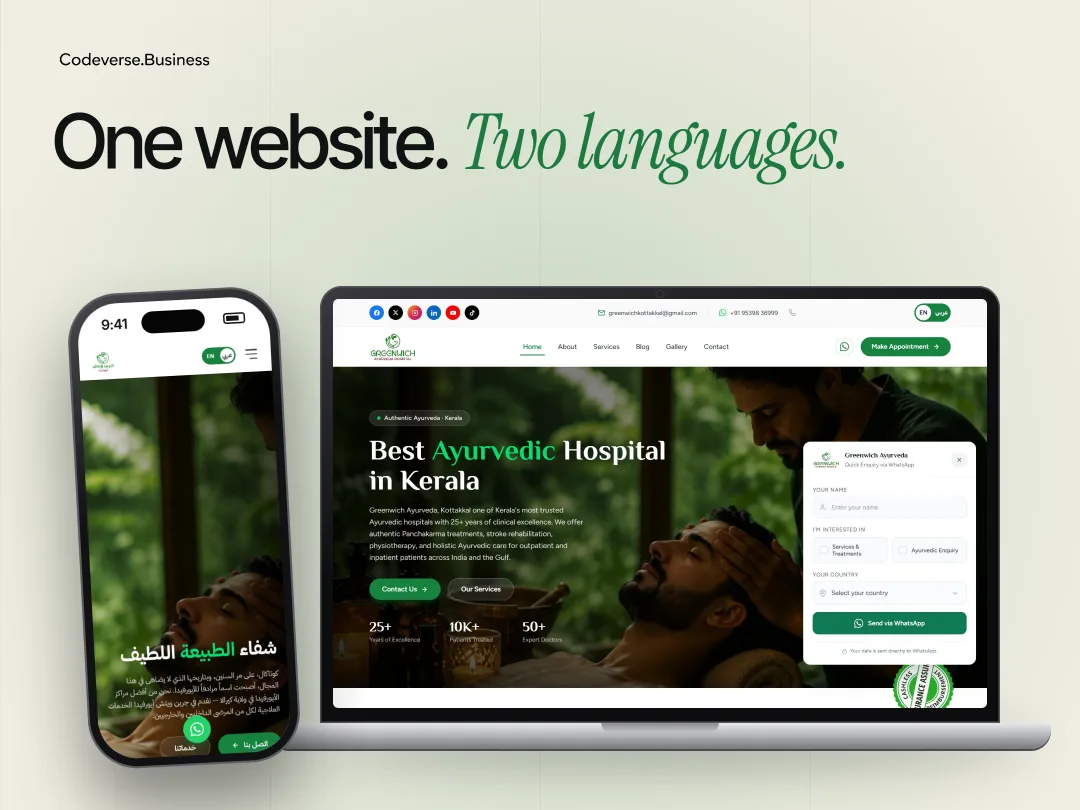
A hospital. Greenwich Ayurveda runs in English and Arabic. Treatments and enquiries appear in both languages, which is the kind of site where a content system pays for itself quickly.
A store. Majestic Furniture and Zendo Hypermarket both depend on product content. A store that needs a developer every time a product changes would not be practical.
Five questions to ask any developer
Before you sign, ask these. The answers tell you what you are really buying.
- Which parts of the site can my team edit without you? Can I see a demo of the admin panel?
- Can I add a new page, or only change text on existing pages?
- Do I own the content and the accounts, and can I leave you and keep everything?
- Can I see the real website working before launch, or only design pictures?
- What happens, and what does it cost, if I want a change after launch?
A confident developer will answer these directly, and vague answers are a warning sign.
How we handle this at Codeverse
We build dynamic websites by default, usually with a Sanity admin panel, set up around your own sections. So instead of a confusing dashboard, your team sees simple forms such as "Home page", "Gallery" or "Offers", and the layout stays protected. We also do not start with static design files. You get a live preview on a private link, phase by phase, and you edit on real pages.
If you are not sure which type you need, send us your website link or your idea on WhatsApp, and we will tell you honestly, even when the answer is the simpler option.
Frequently asked questions
Is a dynamic website slower than a static one?
It does not have to be. Many modern dynamic websites serve pre-built pages to visitors, so they can be very fast, while the content is still edited in an admin panel. Speed depends far more on how the site is built and how images are handled.
Is a dynamic website better for SEO?
Search engines do not prefer one type by name. They care about useful content and a fast, working page. In practice, a dynamic site makes it much easier to add pages and keep content fresh, which is what good SEO needs.
Does a dynamic website cost more?
Usually more at the start, because the admin panel has to be set up. It can cost less over time because you make routine edits yourself. Our website cost guide covers typical market ranges.
Can I convert my static website into a dynamic one?
Yes. It normally means rebuilding the site on a content system and carrying over your useful content. This is a good time to fix anything else that is holding the site back.